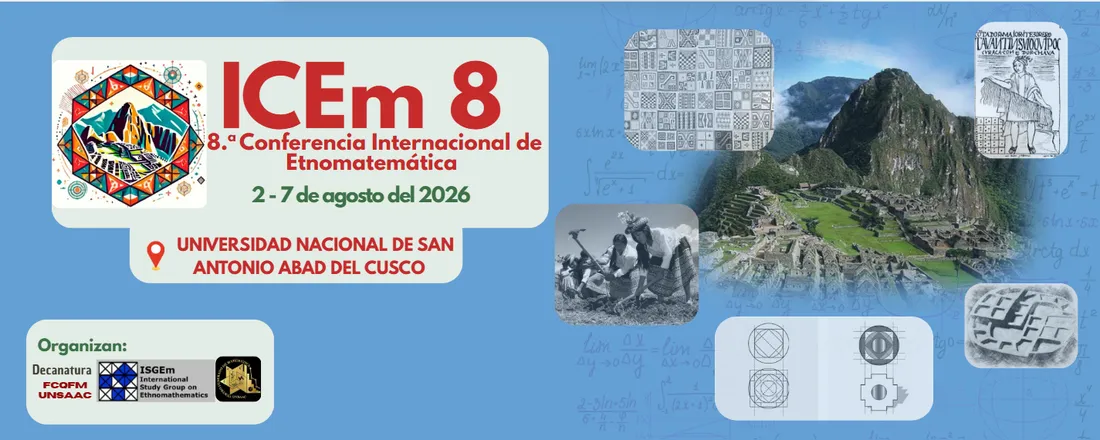
 Universidad Nacional de Santo Antonio Abad del Cuzco - Cusco - Cusco - Perú | Perú - Piruw
 With online streaming
DECOLONIZATION AND ETHNOMATHEMATICS

2 – August 7, 2026
INTRODUCTION
A new academic field is recognized when it has a considerable production of research and publications, an organized community, a journal and courses, seminars, conferences and regular congresses. Scientific production in Ethnomathematics as a field of research in the history and philosophy of mathematics, as well as its pedagogical implications, has increased steadily.
The Ethnomathematics research program was promoted by Ubiratan D'Ambrosio from Brazil, considered by many as the intellectual father of Ethnomathematics, who defined and popularized the term as "the set of modes, styles, arts and techniques (technés or ticas) to explain, learn, know, deal in/with (mathematics) natural, social, cultural and imaginary environments (ethnos) of a culture, that is, Ethnomathematics are the ticas of mathematics in a given ethno" (D'Ambrosio, 2014, p.103). Subsequently, in 1985, the International Study Group on Ethnomathematics – ISGEm was formed (https://isgem.wordpress.com/), which promoted the study of the socio-cultural context of mathematics in its teaching and learning and promoted Ethnomathematics at an international level.
Since 1998, seven international conferences on Ethnomathematics have been held on five continents. Regarding the impact of Ethnomathematics, at present, if a Google Scholar search is carried out for the term Ethnomathematics, it can be seen that there are more than 16,200 results, and if you search with the term Ethnomathematics the result is more than 25,200 publications, which demonstrates the high scientific production on Ethnomathematics. The aforementioned aspects support the need to promote, in the various geographical areas, the study of Ethnomathematics.
In this context, the International Study Group on Ethnomathematics and the Faculty of Chemical, Physical and Mathematical Sciences of the National University of San Antonio Abad del Cusco have determined to promote the realization of the 8th International Conference on Ethnomathematics, an event that will take place from August 2 to 7, 2026 in the city of Cusco, Peru.
General
Promote the dissemination, study and generation of research projects in Ethnomathematics by mathematicians and mathematical educators attending the event, for the integration of the cultural knowledge of indigenous peoples and other minority groups, in the theory and practice of mathematics, as well as in its teaching, as a part of the process of epistemological decolonization.
Specific
• Encourage the production of research projects in Ethnomathematics by teachers and students from the different universities attending the event.
• Create national and international collaboration networks for the development of joint research work with representatives of the institutions participating in the congress.
• To foster spaces for contact between academics from participating institutions to discuss topics on Ethnomathematics.
• To offer undergraduate and graduate students in Mathematics and Mathematics Education the possibility of interacting with international researchers in Ethnomathematics.
• To promote academic production and scientific publications in the field of Ethnomathematics.
• Create a link of scientific cooperation between participating researchers.
• To present innovative experiences for the teaching and learning of mathematics.
• Socialize mathematics teaching and learning practices based on the sociocultural approach.
• To disseminate the contributions of specific didactics of Ethnomathematics and to share ways of mediating the learning of mathematics using various techniques and strategies.
• Broaden the Ethnomathematical perspective to answer current problems/questions.
Decolonization and Indigenous Mathematics: How can Ethnomathematics contribute to the decolonization of science? How does Ethnomathematics overcome epistemological obstacles that impede mathematical learning achievements in basic and higher education? What differences exist between the philosophical paradigm that sustains Western culture as opposed to the philosophical paradigms that sustain Western culture? philosophical paradigms that are at the base of the worldviews of the native peoples? How can Ethnomathematics contribute to grounding the cultural diversity that exists in the way peoples have constructed their knowledge throughout the history of humanity and in diverse geographical spaces, that is, to ground the validity of the epistemologies of the South (Bonilla-Tumialan, 2023) as part of a process of epistemological decolonization (Dussel, 2023). 2025)? Taking into account the social and political dimensions of Ethnomathematics, what would be the conditions that would allow an epistemological dialogue between the various Western and non-Western knowledge systems, in such a way that the self-determination and sovereignty of peoples is respected?
Ethnomathematics
in school contexts: How can Ethnomathematics contribute to transforming
Mathematics Education toward more intercultural, critical, and contextualized
models in diverse sociocultural realities? How can the mathematical knowledge
of indigenous, native, ancestral, marginalized or minority peoples be
integrated into the school curriculum without losing its cultural meaning or
being reduced to mere didactic examples? What epistemological tensions emerge
when academic mathematics and cultural mathematics engage in dialogue, and how
can mathematics education mediate this encounter of knowledge?
Revaluation and Retrieval of Knowledge from Non-Western Cultures: what processes can be developed to recover and revalue the mathematical knowledge of non-Western cultures? How does Ethnomathematics promote the transformation of national education systems by making them relevant to all students through the integration of knowledge cultural? How can Ethnomathematics contribute to the transition of educational systems from an exclusive to an inclusive character? Why is Ethnomathematics important in the reaffirmation of native cultures?
Ethnomathematics and Social Justice: What role does Ethnomathematics play in achieving social and epistemic justice (Bonilla-Tumialan, 2023) indispensable for the construction of a culture of respect, peace and dignity that accepts the socio-cultural diversity of peoples, as well as the understanding of cultural differences through dialogue, respect and tolerance?
Ethnomathematics and Teacher Education: What achievements have been made with Ethnomathematics in initial and continuing teacher education? What is the importance of Ethnomathematics in teacher professional development? What are the difficulties that have arisen with Ethnomathematics in initial and continuing teacher education? consider, from the holistic perspective of Ethnomathematics, in teacher training at the different levels and modalities of teaching (basic, higher, special, bilingual, etc.)?
Ethnomathematics and Critical Mathematics Education: from the political dimension, how can Ethnomathematics be articulated with Critical Mathematics Education to analyze social, cultural and political aspects related to the origins of inequality, inequity and exclusion?
Ethnomathematics and Ethics of Diversity: How does Ethnomathematics contribute to the mathematical practice of marginalized groups and minority sociocultural groups, determined by social, occupational, cultural, generational, geographic (rural or urban), functional (disabilities such as blindness, muteness, deafness, etc.), gender, sexual and neurological (ADHD, autism, etc.)? Does Ethnomathematics facilitate access to diverse bodies of knowledge, since each type of diversity brings unique perspectives and contributes to the cultural enrichment of society?
Ethnomathematics and Sociocultural Modeling: How does Ethnomathematics highlight the original way of mathematizing the cultural practices that each human group has to solve the problems of daily life? What are the advances that have been obtained in ethnomodeling, as a result of the process of cultural mathematization and what does reality represent to study it? predict and transcend their behavior?
Ethnomathematics and the Linguistic Dimension: How does Ethnomathematics contribute to research on linguistic terms that signify mathematical notions, properties and objects in each of the languages?
Ethnomathematics and the Socio-Ecological Dimension: what is the contribution of Ethnomathematics in research on the social, political and ecological problems related to climate change, health crises and their impact on poverty, inequality, discrimination and marginalization? How do the results of this socio-ecological research, of a interdisciplinary, can contribute to improving mathematics education?
ICEm 8 VENUE
Universidad Nacional de San Antonio Abad del Cusco.
Address: Avenida De la Cultura, No. 733, Cusco – Peru.
Paraninfo in the Plaza de Armas of Cusco
+ 51 949267315
WEB PAGE
8th International Conference on Ethnomathematics/ 8th International Conference on Ethnomathematics/ 8th International Conference on Ethnomathematics
https://www.even3.com.pe/e/ICEm8-632441Ethnomathematics researchers, mathematicians, officials of the Ministry of Education, primary school teachers and secondary school mathematics teachers, bilingual intercultural education teachers, general education teachers, mathematics students and students in teacher training at primary and secondary levels, interested public.
Teachers and students of the Universidad Nacional San Antonio Abad del Cusco will enjoy free admission to ICEm 8.
Plenary or parallel lectures, presentations by prestigious invited expert researchers on a specific topic over the course of an hour.
Round tables, a dynamic debate that brings together a group of participants to present and develop their opinions and points of view on a certain subject related to the areas of interest in Ethnomathematics.
Oral communications can account for the results of research or about learning experiences applied in a classroom or about the dissemination of the knowledge of native peoples. The presentation lasts twenty minutes.
Workshops, a planned and structured process of learning, which involves participants actively contributing and has a specific purpose. It lasts an hour and a half.
Posters, which may be presented on paper or other material. Posters may not be proposed by people who make oral communications or workshops.
Exhibition of materials. The UNSAAC will provide a space for books and materials related to Ethnomathematics, Mathematics and Mathematics Education to be exhibited.
Label_DoacaoAPartir {{item.valores[0].valor | currency:viewModel.evento.moeda}}
{{item.descricao}}

{{item.nome}}
{{areaSiteEvento.jsonObj.configuracaoSubmissao.dataInicioSubmissao}} - {{areaSiteEvento.jsonObj.configuracaoSubmissao.dataLimiteSubmissao}}
Soon
{{viewModel.evento.dataInicio}} –{{viewModel.evento.dataFim}}
{{viewModel.evento.local}}
Get directions
Call for Expressions of Interest to Host ICEm9
Dear members of the Ethnomathematics Community,
On behalf of the Executive Board of ISGEm, I am pleased to extend the following invitation:
Call for Expressions of Interest to Host ICEm9
Ethnomathematics Groups, Universities, and Educational Institutions interested in hosting the 9th International Conference on Ethnomathematics (ICEm9), to be held in 2030, are invited to submit a written Expression of Interest to the President of ISGEm, Prof. Dr. Milton Rosa, by 31 July 2026 (milrosa@hotmail.com).
The Expression of Interest should be 2 pages in length and include:
· The name of the hosting institution.
· The names of the proposed leaders (and other team members, if available).
· The proposed venue for hosting the congress.
· The proposed dates for the conference.
· Any additional relevant information.
Please also include a formal letter of support from the institution confirming its willingness to host the event.
The final decision will be made at the ISGEm Assembly on August 6th, 2026, in Cusco, Peru.
We look forward to receiving your expressions of interest.
Sincerely,
Prof. Dr. Milton Rosa
President, ISGEm
Jason
Johnson. Emirates
College for Advanced Education - United Arab Emirates
Submission of proposals ............................................................ May 15, 2026.
Return of evaluated proposals............................................. May 31, 2026.
Submission of applications for Ubiratan D''''Ambrosio ...... scholarships May 15, 2026.
Notification of Ubiratan D''''Ambrosio Scholarship Applications ........ May 31, 2026.
Over 27 years, the following Ethnomathematics conferences have been held:
- First International Congress of Ethnomathematics. Granada, Spain - 1998
https://www.ugr.es/~oliveras/ICEM1ES.html
- Second International Conference on Ethnomathematics. Ouro Preto, Brazil - 2002
https://www.scirp.org/reference/referencespapers?referenceid=2927045
- Third International Conference on Ethnomathematics (ICEm-3). Auckland, New Zealand - 2006
https://www.math.auckland.ac.nz/Events/2006/ICEM-3/1.Keynote/D%27Ambrosio-plenary-prez..ppt
- Fourth International Conference on Ethnomathematics. Towson, Maryland, USA - 2010
- 5th International Congress on Ethnomathematics. Maputo, Mozambique - 2014
- 6th International Conference on Ethnomathematics. Medellín, Colombia - 2018
https://www.etnomatematica.org/home/wp-content/uploads/2017/12/ICEm6_EN.pdf
- 7th International Conference on Ethnomathematics. Papua New Guinea, Philippines, Nepal and Indonesia - 2022
Bonilla-Tumialan, M. C. (2023). Ethnomathematics and Complexity: a study of the
process of elaboration of a Peruvian Andean textile. In M. C. Borba & D. C.
Orey (Eds.). Ubiratan D''''Ambrosio and Mathematics Education: Trajectory,
Legacy and Future (Advances in Mathematics Education), pp. 179-200. Springer. https://link.springer.com/book/9783031312922
D''''Ambrosio,
U. (2014). The conceptual bases of the Ethnomathematics Program. Magazine
Latin American Ethnomathematics, 7(2), 100-107.
Dussel, E. (2025). Towards a
theory of Modernity/Coloniality. Epistemological decolonization.
Editorial Akal.
